

Can AI produce a reliable deep-tech market study? We put it to the test.
To evaluate AI’s practical efficacy, TEMATYS conducted a series of tests using Gemini 3 Pro (February 2026 version) to analyse the hyperspectral imaging market—a sector for which TEMATYS has published the third market report update in December 2025. This report was made without AI assistance.
This white paper, published by TEMATYS in February 2026, examines the intersection of deep-tech marketing and artificial intelligence. While Large Language Models (LLMs) like Gemini 3 Pro have revolutionized information processing, their application in specialized sectors like photonics requires a nuanced understanding of their strengths and fundamental limitations.
The Critical Role of Marketing in Deep-Tech
Marketing in the photonics industry is an integral component of the product development process, rather than a final promotional step. It acts as the primary driver for technological evolution by defining the requirements of future customers. TEMATYS outlines the two primary frameworks for this development:
- The Push Model: This traditional approach starts from a newly developed technology for which marketing’s role is to determine the practical applications—asking, “What can it be used for?”.
- The Pull Model: This model is less common but very efficient. It begins with a fully marketing-driven phase to analyse customer needs and define a product as a solution.
In both models, marketing is essential for specifying products, sourcing external technologies, and validating prototypes through early-user feedback.
Unique Challenges of the Photonics Industry
Photonics, like all deep-tech hardware sectors, possesses specific characteristics that create the need for specific marketing approaches:
- Transversality: A single photonic technology can serve diverse functions—measuring, acquiring information, transmitting data, manufacturing and various end markets. The challenge lies in identifying which specific application will yield a truly profitable market.
- Slow Maturation: It takes an average of ten years for a photonics start-up to achieve significant growth. This is due to heavy capital requirements, the complexity of managing multidisciplinary teams (physics, electronics, software), and the time needed for non-expert customers and end users to understand the technology’s benefits.
- Niche Market Structure: Aside from mass markets like lighting or telecommunications, photonics is a “constellation of small and mid-size niches”. These markets often rely on “progress through available opportunities,” using components developed for high-volume sectors to create specialized industrial tools.
Information Sources and the Advent of AI
Strategic marketing relies on four key information pillars: Internal Knowledge, Literature search and databases, Conferences & Exhibitions, and People (customers, suppliers and end-users).
LLMs are currently positioned as a transformative tool for searching, compiling/ curating/collating and processing published information on the Web. However, TEMATYS emphasizes that regardless of AI’s efficiency, it only addresses one pillar of the marketing process: the analysis of past and published and open-source data. The future of a product, by contrast, is co-created through human-to-human interactions and joint product development with stakeholders.
Empirical Testing: AI vs. Expert Reality
To evaluate AI’s practical efficacy, TEMATYS conducted a series of tests using Gemini 3 Pro (February 2026 version) to analyse the hyperspectral imaging market—a sector for which TEMATYS has published the third market report update in December 2025. This report was made without AI assistance.
While the AI provided structured and seemingly clear responses, significant discrepancies became apparent upon closer inspection:
- Market Inflation: The AI estimated the 2026 hyperspectral market at $1.9 billion. Whereas, TEMATYS experts estimate the actual camera market at only $140 million.
- Definitional Failure: The AI conflated “hyperspectral” (typically >30 bands) with “multispectral” imaging, and failed to separate the cost of a “camera” (the sensor) from the “system” (e.g., a satellite or a $1 million waste sorting machine).
- Inconsistency: Repeating the exact same prompt led to different, and sometimes worse, results, including a misunderstanding where the AI claimed, “The camera market alone was worth billions while the leader’s revenue was under $50 million”.
- Uncritical Sourcing: The AI cited reputable-sounding market reports but failed to recognize that their forecasts varied wildly — from $292 million to $1.9 billion. It treated any published document as a valid fact.
Lessons Learned for the Deep-Tech Sector
The test campaign yielded several “lessons” for professionals using AI in technical fields:
- AI is a Partial Solution: It cannot replace the proactive, human-centered aspects of marketing.
- The Precision Trap: Precise prompts are required to avoid errors, yet users often lack the precise vocabulary of a new topic until they have researched it. It will be seen that using a LLM for producing a consistent market study is a challenge. But expecting a good result from an approximate prompt is an illusion.
- The “Truth” Limitation: AI is designed to provide an answer regardless of the quality of its training data and does not possess a critical understanding of the “truth” in market reports used for its training. Besides that, LLMs rarely say that they don’t know the answer..
- No Detection of Ambiguity: LLMs rarely ask for clarification when a prompt is vague, leading to potentially dangerous misinterpretations of technical data.
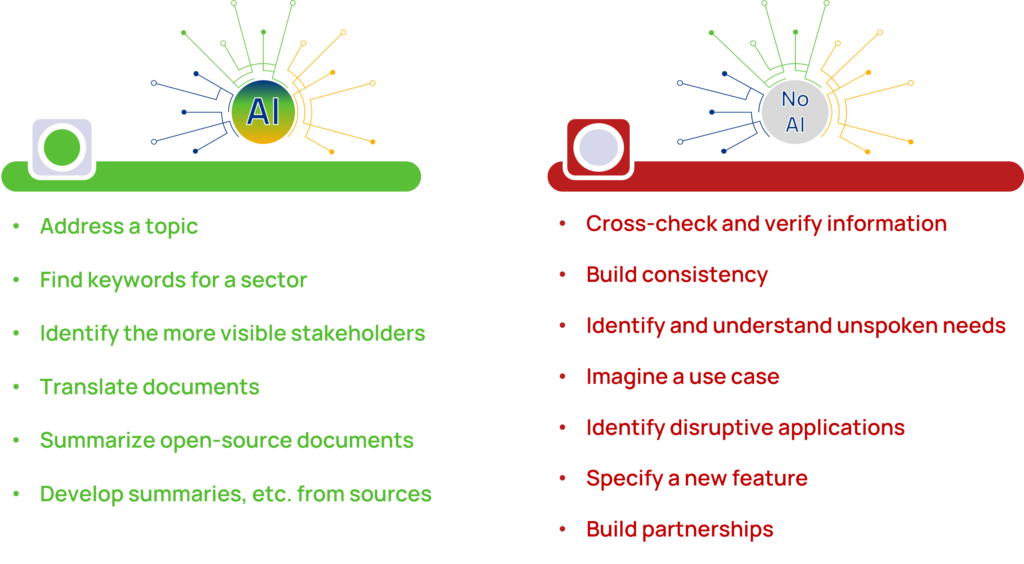
Strengths and weaknesses of AI for producing a market study in deep-tech.
The TEMATYS Value Proposition: Human Intelligence
While AI is very good tool for approaching a topic, finding keywords, and summarizing bibliographic documents, human analysts provide the crucial “added value”:
- Verification: Cross-checking data by understanding the author’s context, methodology, and potential biases.
- Clarifying Needs: Working with scientists and engineers, who may have a “dream concept” but lack a clear view of commercial reality.
- Co-Creation: Engaging is the “nicest part of the job”—talking to early adopters and future clients to build a common future and ensure technology serves actual needs.
- Classify opportunities: AI can provide a list of potential applications for a technology or product, but it is through interactions with customers that we can understand what the real opportunities are.
Conclusion
In the specialized world of photonics, AI is a powerful assistant for processing the past, but the future remains a human invention. A comprehensive marketing strategy requires the ability to identify unspoken needs and build real-world partnerships—tasks that remain firmly outside the capabilities of current Large Language Models.