
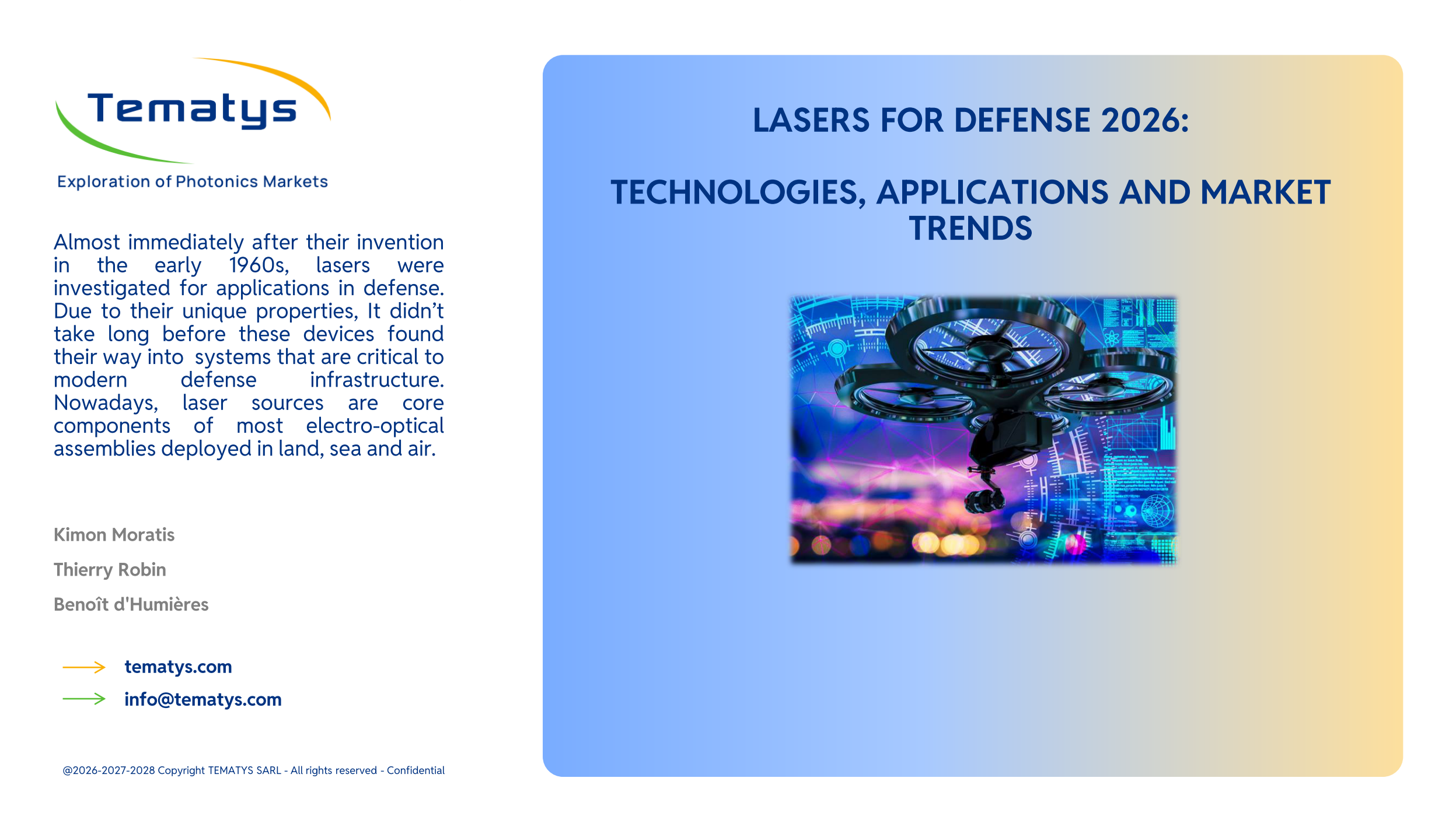
🚀 Drone Warfare Is Shaping the Industry of Lasers for Defense
TEMATYS launches the Global Market of Lasers for Defense 2026 report, providing strategic insights into the role, applications and market potential of lasers in modern defense systems.
The defense landscape is undergoing a profound transformation. Fueled by ongoing conflicts in the Middle East and along the eastern borders of Europe, as well as growing uncertainty around traditional alliances, global investments in military equipment and defense systems reached nearly $2.9 trillion in 2025.
At the same time, the nature of warfare itself is changing. Among the technologies reshaping modern military operations, drones have emerged as a major driver of new requirements for defense systems—and, increasingly, for advanced electro-optical technologies and lasers.
Drone warfare is reshaping modern defense
Drone technology has fundamentally shifted conflict away from platform-centric operations toward distributed, low-cost and attritional warfare.
Cheap FPV drones and loitering munitions can strike high-value assets with precision, while persistent overhead Intelligence, Surveillance and Reconnaissance (ISR) reduces tactical surprise and contributes to an increasingly transparent battlefield. Unmanned aerial systems can transmit real-time coordinates directly to artillery, dramatically compressing sensor-to-shooter loops, while autonomous swarms can overwhelm conventional air-defense systems through sheer numbers.
Non-line-of-sight strikes, tethered optics and rapid software modifications further enable combatants to overcome traditional terrain cover and electronic countermeasures. These developments are forcing modern military doctrine to place greater emphasis on low-altitude perimeter security and rapid detection and engagement of small aerial threats.
This evolution is creating new demand for advanced Electro-Optical (EO) and Infrared (IR) defense systems.
EO/IR systems become a critical layer of drone defense
Small, low-flying drones can be difficult for conventional radar and radio-frequency-based systems to detect and track. Multi-sensor EO/IR gimbals can address part of this challenge by providing passive, silent optical tracking, allowing operators to detect and identify targets without actively emitting signals that could reveal defensive positions.
Mid-wave and long-wave infrared thermal imaging can detect the heat signatures associated with drone motors and other components, including in low-light and nighttime conditions. Combined with AI-driven image processing, these systems can rapidly distinguish potential threats from birds, vegetation and other background clutter.
Modern EO platforms can also integrate high-magnification optical zoom and laser rangefinders, providing the precise tracking and targeting data required by remote weapon stations and emerging directed-energy systems.
As autonomous and radio-silent drones increasingly reduce the effectiveness of conventional electronic-warfare approaches, electro-optical technologies are becoming an increasingly important layer for visual identification, tracking and hard-kill targeting.
Where lasers fit into the drone warfare ecosystem
The growing role of unmanned systems is also creating demand for lasers across multiple stages of the defense technology chain.
Laser rangefinders have become important payloads for drones and loitering munitions, providing rapid and accurate distance measurements and battlefield data. UAVs equipped with compact laser target designators can support precision engagement in complex operational environments where speed, agility and accuracy are critical.
Lasers are also core components of Fiber Optic Gyroscopes (FOGs), which provide high-precision inertial sensing for autonomous navigation, including in GPS-denied environments.
Beyond sensing and navigation, Free-Space Optical (FSO) communications can provide high-bandwidth and secure data transmission between satellites, aircraft, UAVs and ground-based systems. These capabilities become increasingly relevant as military forces seek resilient communications architectures that can operate in contested electromagnetic environments.
At the end of the defense chain, Laser Directed Energy Weapons (LDEWs) are emerging as a potential complementary approach to conventional air defense, particularly against drones and other low-cost aerial threats. Their potential for rapid engagement and low marginal cost per shot makes them an area of increasing interest as armed forces face the challenge of defending against large numbers of relatively inexpensive unmanned systems.
From detection to engagement: a growing laser opportunity
The evolution of drone warfare illustrates that the defense laser market is not limited to directed-energy weapons.
Lasers already play roles across a broader ecosystem encompassing:
- Detection and identification
- Rangefinding and targeting
- Target designation
- Navigation and inertial sensing
- Secure optical communications
- Tracking and fire control
- Directed-energy weapons
The increasing integration of these capabilities into defense architectures is creating opportunities across the laser value chain, from laser sources and components to complete electro-optical systems and weapon platforms.
Understanding where these opportunities are emerging—and how quickly they may develop—is therefore essential for companies operating across the photonics and defense industries.
TEMATYS launches the Global Market of Lasers for Defense 2026
The Global Market of Lasers for Defense 2026 report by TEMATYS examines the evolving role of laser technologies in defense and the market opportunities associated with their growing adoption.
The report provides strategic insights into the applications, technologies, market dynamics and future potential of lasers for defense, helping industry stakeholders understand how developments in modern warfare are translating into technology and market requirements.
For laser manufacturers, component suppliers, photonics companies, defense-system developers, investors and other industry stakeholders, the report offers a strategic view of a market increasingly shaped by the convergence of photonics, autonomous systems, AI, electro-optics and directed-energy technologies.
Download the flyer to discover the Global Market of Lasers for Defense 2026 report by TEMATYS and learn more about the key market trends and opportunities shaping the future of defense lasers.